The Fourth Bell
The Haberfelde Building Basement · Bakersfield, California
It was high and bright, not unlike the bell above the door of an old shop. The second note came six seconds later. It was lower and carried a faint metallic rattle. The third made two tones at once, as though its bronze had cracked.
After the third bell, iron wheels began moving under the floor.
Mara stopped typing.
She was alone in her fourth-floor office in the Haberfelde Building. The last restaurant workers had left more than an hour earlier, and the cleaning crew had finished before midnight. Beyond her window, the corner of Chester Avenue and 17th Street stood empty beneath the orange wash of the streetlamps.
The wheels rolled north.
They did not sound like a cart moving in the street. The sound was too enclosed, each turn followed by a short reverberation. Mara had spent nineteen years restoring damaged audio for attorneys, insurers and government agencies. She could identify a room by the frequencies that lingered after a door closed. The sound below her had the close, hard echo of a brick passage.
She listened until the wheels stopped.
Then a fourth bell sounded.
Mara did not hear that one through her ears. She felt it pass up the steel legs of her desk and into her jaw. The pressure made her teeth ache.
Her office became silent again.
On another night, Mara might have called the building’s emergency number and gone home. That night she was tired, irritated with a report that refused to end and unwilling to spend the next week wondering whether a loose pump was shaking the structure. She knew enough about old buildings to expect a mechanical explanation for almost every mystery.
She also knew about the tunnels.
George Carl Haberfelde, a German immigrant who became a successful automobile dealer and served as Bakersfield’s mayor, had commissioned Charles Howatt Biggar to design the five-story office-and-retail building after returning from a world tour in 1924. Completed in 1927, the Sullivanesque landmark was then one of the tallest buildings in the southern San Joaquin Valley.
The building’s underground history was less orderly.
For generations, Bakersfield stories had turned every cellar door into the entrance to one enormous secret city. The researched history was smaller. Local historians described three separate tunnel systems, not one endless labyrinth. Two were associated with Bakersfield’s two early Chinatowns. A later commercial set near Chester Avenue and 19th Street had been built after the destructive downtown fire of 1889 and used to move goods between businesses.
A brick-lined passage could still be seen from the basement of the Merry Go Round Antique Mall. Local accounts described other blocked entrances, including one in a building on Eye Street and another in or near the Horse in the Alley space adjoining the Haberfelde Building.
Mara had always assumed the old freight route explained the occasional tunnel story told by downtown tenants. Pipes carried voices. Utility chases made distant impacts sound close. A delivery cart in one basement could seem to move beneath another building.
But there should not have been a delivery cart anywhere beneath downtown at two in the morning.
She took a small flashlight from her desk.
Her telephone remained connected to its charger. So did the professional recorders locked in two hard cases beside the bookcase. She expected to be downstairs for less than five minutes. She did not start an audio file, take a photograph or leave a message telling anyone where she was going.
No one knew that she left her office.
Mara took the stairs to the basement.
The lower she went, the cooler the building became. The stairwell lights turned on ahead of her and went dark behind her. At the basement landing, she unlocked the fire door with her tenant key.
The room beyond was ordinary.
Modern pipes crossed beneath old beams. Wire cages held restaurant supplies, unused office furniture and boxes belonging to tenants who had forgotten them. Painted concrete divided storage areas that had been altered many times since 1927.
Mara walked east, toward the place directly beneath her office.
The wheels began again.
They moved on the other side of the basement wall.
The nearest shelving unit trembled. A line of dust dropped from behind it, outlining the curve of a brick arch concealed beneath the paint. Mara moved two empty cartons and found a narrow iron door fitted inside the arch.
She had visited the basement before. There had never been a door there.
Its iron was cold enough to hurt her fingertips. The latch lifted without resistance.
Cool air breathed through the opening.
Mara shone her flashlight inside.
A brick passage extended beyond the beam. Two parallel grooves ran through the dust on its floor, spaced like the wheels of a narrow handcart. An iron wire followed the wall at shoulder height and disappeared into darkness.
The sensible part of Mara’s mind told her to close the door.
Another part observed that the arch was stable, the passage appeared dry and the air smelled stale but not chemical. She could walk far enough to see whether the route ended at a blocked wall. She did not need a crew to look around a corner.
That was how she later explained the decision.
The truth was that she wanted the tunnel to be real.
She entered alone.
There was no safety line around her waist. No one waited at the entrance. She had no radio, gas monitor, helmet or second light. The only person who could decide when she had gone far enough was Mara.
She pulled a mechanical pencil from her jacket and drew a short arrow on the brick beside the door. Then she stepped into the passage.
The iron door closed behind her.
Mara turned immediately and pushed against it. The handle had vanished. Her light showed a flat wall of brick where the door had been.
The pencil arrow remained.
She touched the mortar. It was hard, cold and old.
“No,” she said.
Her voice traveled into the passage.
No. No. No.
The final echo came back in a voice that was not hers.
“Which building?” it asked.
Mara did not answer.
She examined the wall until her fingers hurt. There was no seam, hinge or latch. The pencil arrow proved she had not turned around, but it did nothing to explain how the entrance had disappeared.
Somewhere ahead, the first bell rang.
The old wire along the wall quivered.
Whatever lay at the other end of the passage might include another exit. The local accounts placed the former commercial route beneath more than one building. Mara marked a second arrow and walked deeper.
The tunnel was tall enough for her to stand upright. Its brickwork changed every few yards, older red courses interrupted by harder repairs. Shallow niches appeared at intervals, wide enough for one cart to wait while another passed.
Mara counted her steps.
At forty-three, she heard glass bottles clinking ahead.
At sixty-one, a telephone rang behind the wall.
At eighty, someone whispered her name.
“Mara.”
The voice belonged to her mother, who had been dead for eleven years.
Mara stopped walking.
“You left your phone upstairs,” her mother said. “How will anyone know where to find you?”
Mara pressed her lips together.
The voice moved through the brick beside her. It did not sound like a memory. It included the slight whistle her mother had made on words beginning with f, a change that had appeared after dental surgery during the final year of her life.
“Tell me which building,” her mother said. “I’ll come get you.”
Mara resumed walking.
The voice followed for twenty steps, becoming less patient.
“You always did this,” it said. “You went quiet when you knew you were wrong.”
Then it began to use Mara’s voice.
“I’m in the Haberfelde basement,” the tunnel said as Mara. “Seventeenth and Chester.”
She felt something move past her in the dark.
Not air. Weight.
The second bell rang.
Wheel noise approached from ahead.
Mara stepped into the nearest passing niche and turned off her flashlight.
 The cart came slowly.
Its iron wheels found every crack in the floor. A loose board creaked beneath its load. Behind it walked an invisible porter whose boots left fresh impressions in the dust, one print appearing after another.
The cart carried a canvas-covered shape.
As it passed the niche, the cloth slipped.
There was no body beneath it.
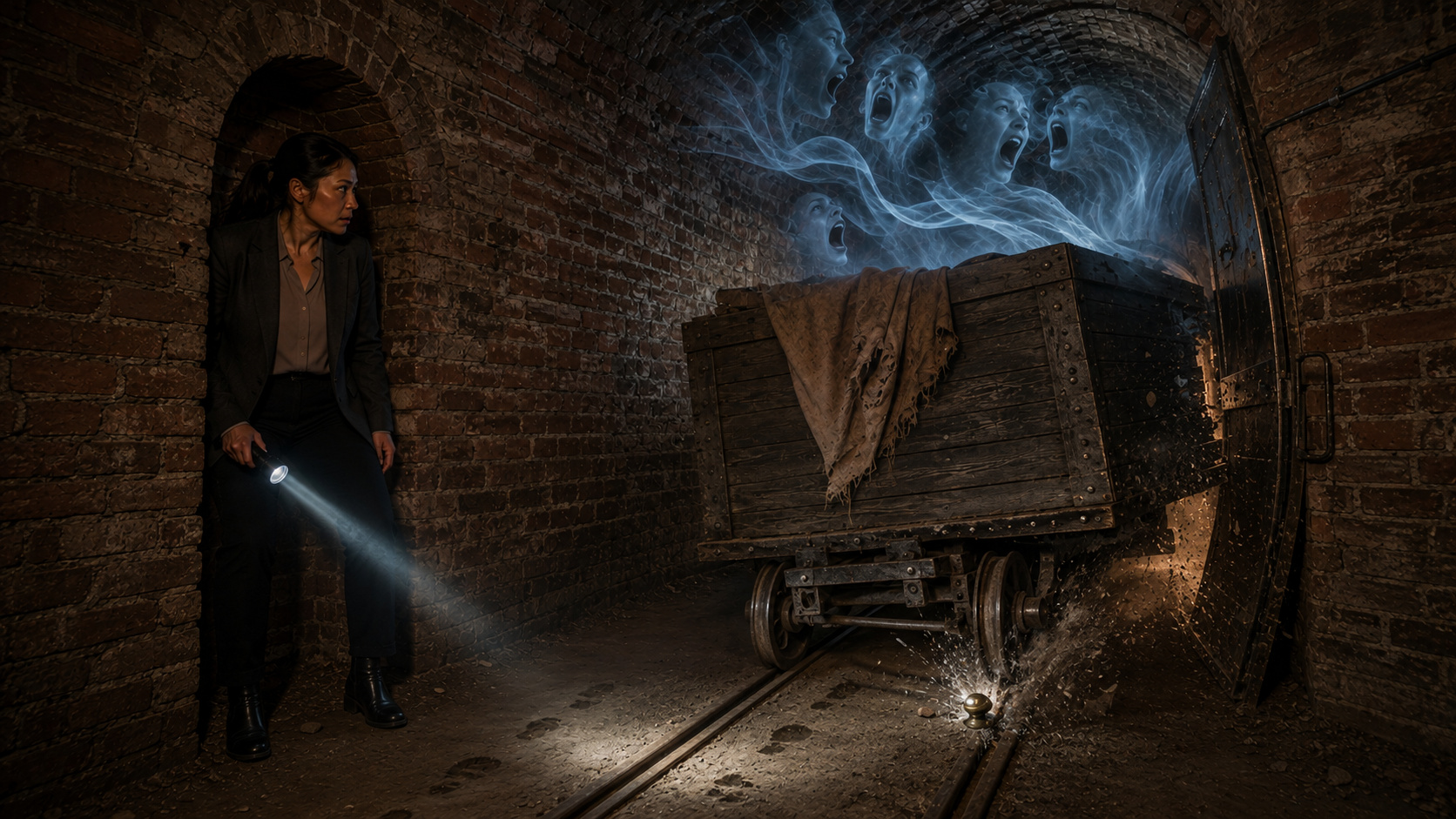
The cart carried voices.
They lay in layers like transparent film, each given the faint shape of the mouth that had made it. A child’s cry fluttered against an old man’s cough. A woman’s laugh opened and closed without a face. Pleas, questions and fragments of ordinary conversation moved over one another, trapped beneath the canvas without lungs.
Mara’s mother was among them.
So was Mara.
Her own voice whispered from the cart, “I told it where we are.”
The invisible porter stopped.
One boot print appeared directly in front of Mara’s niche.
Then another appeared beside it.
The porter had turned to face her.
Mara held her breath.
From beneath the canvas, the collected voices asked together, “Delivery?”
She remained silent.
The cart moved on.
Mara waited until the wheels diminished, then relit her flashlight. Her hand was shaking. The beam struck the pencil arrow she had drawn on the wall when she entered the niche.
It pointed deeper into the tunnel.
She was certain she had drawn it toward the entrance.
Mara drew a new arrow in the opposite direction and added three lines beneath it. She walked away from the cart.
After twenty steps, she found the same arrow.
It now had four lines beneath it.
The fourth bell sounded through the soles of her shoes.
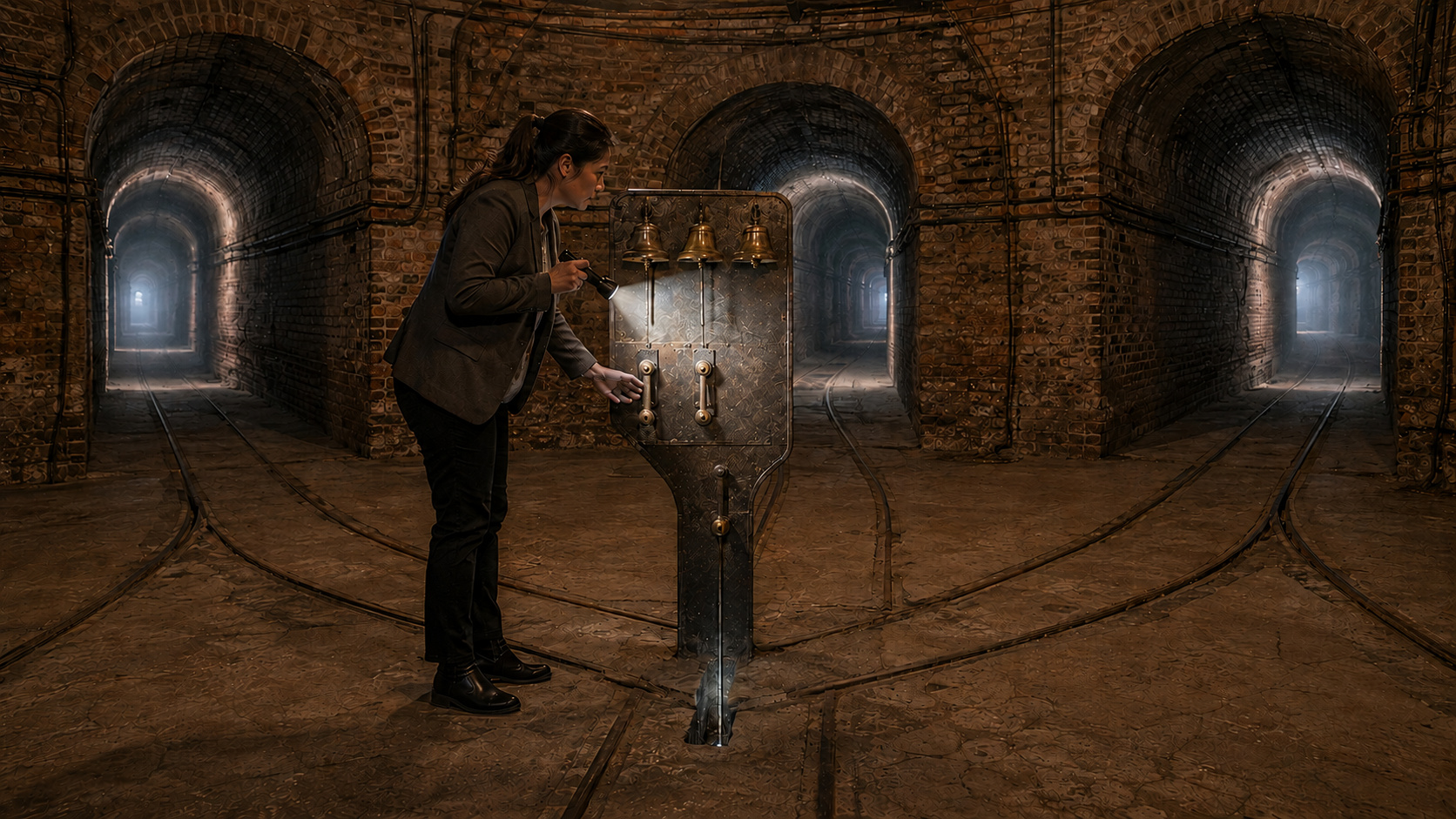
The wall beside the mark opened into a low junction chamber.
Three brick arches faced her.
The left branch climbed gently toward a wall stenciled with a faded 19. The right bore the single word EYE. The center route bent south. Someone had scratched 17 into its brick.
Seventeenth Street meant the Haberfelde.
At the middle of the chamber stood a cast-iron post with three small bells.
The first was high and bright.
The second was lower and loose in its bracket.
The third had a visible crack.
Beneath them were three pull handles connected to wires running into the marked passages. Mara understood the practical purpose. A worker moving goods underground could ring for the receiving building. One signal sent a cart toward Seventeenth Street. Another directed it toward Nineteenth. A third called toward Eye.
There was also a fourth handle.
It had no bell above it.
Its wire entered the floor.
A small brass plate beneath the handle had been turned backward. Mara rotated it with one finger.
No street or number was engraved on the other side.
There was only a single word.
BELOW.
Mara heard the cart returning.
It came from the branch marked EYE.
She seized the first pull handle and rang once for Seventeenth Street.
The high bell answered.
Far down the center route, an iron door opened with a metallic blow.
At the same moment, the fourth handle pulled itself.
The bell without a bell sounded inside Mara’s bones.
Bricks withdrew from the wall between the marked arches. They moved backward without falling, revealing a shallow chamber where no chamber could fit among the other routes.
Its floor was crowded with people.
They stood shoulder to shoulder in clothing from many decades, yet Mara could see the bricks through them. Their mouths opened and closed. None produced its own voice. Every sound came instead from the approaching cart: prayers, names, laughter, final shouts and simple questions that had never been answered.
At the front stood a woman in a white operator’s blouse. Her head was tilted as if she had been listening for a connection for a very long time.
“Origin?” the woman asked in Mara’s voice.
The crowd took one step forward.
“Destination?”
Mara understood then why the tunnel wanted a location.
It had been built to carry objects from one known place to another. Every load had an origin. Every load required a destination. When sections were blocked and basement doors sealed, signals went unanswered. Carts did not return. Voices entered through brick and pipe, but without an open building to receive them, they remained in transit.
The thing below was not asking who she was.
It was asking where to deliver her.
The cart entered the junction.
The canvas had fallen completely aside. The collected voices rose from the cart in a human-shaped column, hundreds of pale mouths opening across its surface.
Mara’s mouth floated near the top.
“Haberfelde Building,” it said with her voice. “Basement. Seventeenth and Chester.”
The cart turned toward the center route.
“Delivery accepted,” Mara’s stolen voice announced.
Her throat closed.
Mara tried to speak. Air passed through her mouth without sound. She stamped one foot and heard nothing. Even the rustle of her jacket had vanished.
The tunnel was not merely carrying a copy of her voice.
It had taken every sound that belonged to her.
The invisible porter began pushing the cart toward the Haberfelde.
Mara ran ahead of it.
Her footsteps made no noise. She could feel each impact through her legs but heard only the accelerating wheels behind her. The soundless crowd followed from the open wall, mouths working while the cart spoke for them.
The center passage bent south. Mara’s pencil marks appeared at intervals, but every arrow pointed back toward the junction. She ignored them. The route climbed slightly, and she trusted the slope more than the marks.
The voices called from behind.
Her mother begged her to slow down.
A child screamed that he was caught beneath a wheel.
Then Mara heard herself sobbing.
“Please,” her voice said from the cart. “I’m the one behind you.”
She did not turn around.
The passage divided around a brick pier. From the left branch came the sound of Mara running. From the right came her ragged breathing. Straight ahead, her stolen voice called for help.
She ignored all three.
With one hand against the brick, she found the iron signal wire. Only the right branch carried it upward toward the bell she had rung. She followed the metal instead of her stolen sounds.
The right branch led her back to the Haberfelde door.
It stood inside the brick arch, closed and without a handle.
The cart rounded the final bend.
Mara struck the iron with both palms. The blows were silent. No one waited on the other side. No one knew she was below the building. Even if she could have shouted, the basement was empty.
The cart was thirty feet away.
Above it, the column of mouths spoke gently.
“We know who you are,” they said. “We know where you belong.”
Something pressed against Mara’s back. There were no visible hands, yet finger-shaped hollows appeared in the dust on her jacket.
She reached for the iron wire that followed the tunnel wall. It ended beside the door in a broken loop. Mara pulled.
Somewhere far behind her, the first bell rang.
The door remained closed.
The cart reached twenty feet.
Mara pulled the wire again. The high bell rang a second time.
A lock moved inside the door, but the iron did not open. The old system had called the Haberfelde. No one above remained to receive the delivery.
The cart reached ten feet.
Mara looked at the wheel grooves. She looked at the cart. Then she remembered the loose bracket beneath the first bell.
She still had the mechanical pencil in her pocket.
Mara ran back toward the junction.
The invisible porter tried to seize her. Dust compressed around her wrist, but her silence made her slippery. The thing could carry her voice. It could direct her echoes. It did not seem able to judge the position of a body that produced no sound.
She flattened herself against the wall.
The cart rolled past.
Mara followed it into the junction.
The soundless crowd turned toward her. Their mouths opened, and Mara’s voice came from every one.
“Below,” they said.
The fourth handle lowered itself.
Mara jammed her pencil through the hinge.
The handle stopped halfway down.
The fourth bell struck without completing its note. The chamber convulsed. Bricks trembled in their courses. The transparent crowd folded inward as though drawn by a sudden current.
Mara gripped the first bell and twisted.
Its corroded bracket broke.
She tore the bell from the post and ran for the center passage.
The cart turned behind her.
It followed the stolen sound of her voice toward Seventeenth Street.
Mara reached the iron door and knelt beside the grooves. She placed the brass bell on its side in the right-hand track and wedged its broken bracket into a crack in the floor.
Then she stepped into the shallow niche beside the arch.
The cart came fast.
Its wheels struck every seam in the floor. The invisible porter left no walking prints now; the impressions landed yards apart, as though it were running.
The voices above the cart rose into a single demand.
“Destination?”
The front wheel hit the bell.
Brass collapsed beneath iron. The cart climbed, twisted and left its groove. Its side struck the service door with enough force to bend the frame.
The voices scattered.
They filled the tunnel like a flock released indoors. Cries, laughter, names and unanswered questions struck the walls and rebounded through one another. Mara’s voice hit her in the chest.
Sound returned to her body.
She screamed.
The bent iron door opened two inches.
Mara forced her fingers into the gap and pulled. Something took hold of her ankle. She kicked backward, felt her heel strike wood and heard the cart splinter.
The opening widened.
She pushed one shoulder through, then her head and both hands. Behind her, the tunnel spoke in the voices of every person she had ever loved.
“Mara, stay.”
Invisible weight dragged her toward the wheel grooves.
She caught the outer edge of the brick arch and held on.
The air filled with the smell of hot masonry.
For an instant Mara heard a town burning in 1889, wagons rattling over dirt, merchants rebuilding in brick, freight descending beneath the new sidewalks, the earth convulsing in 1952, doors closing, passages being blocked and unanswered bells calling into smaller and smaller darkness.
Then she pulled herself across the threshold.
The iron door slammed behind her.
The fourth bell struck once beneath the foundation.
Mara lay on the basement floor, coughing and shouting simply to hear herself.
When she turned toward the arch, there was no door.
The east wall was flat and unbroken. Painted concrete block occupied the place where the bricks and iron should have been. The shelving unit stood in front of it, bolted to the floor and filled with boxes too heavy for Mara to have moved.
She examined herself beneath the fluorescent lights.
Her jacket was clean. No finger-shaped hollows marked the dust because there was no dust. Her shoes carried none of the tunnel’s gray powder. Her palms were uncut. The ankle that had been seized bore no bruise.
The mechanical pencil was back in her pocket, straight and unbroken.
Her flashlight worked normally.
The bell was gone.
Mara ran upstairs.
Her phone remained beside the report, still charging. No call, message, photograph or audio file documented where she had gone. The clock showed 2:04 a.m.
Six minutes had passed.
Mara remembered nearly an hour underground.
She did not finish her report.
The following morning, she told the building’s management that she had found an iron door in the east basement wall and entered a tunnel connected to other downtown buildings. She described the wheel grooves, the junction, the bells and the cart.
The wall was inspected.
Its paint was old and uninterrupted. The shelving bolts had not moved. No hollow space appeared immediately behind it. The available plans showed no door.
Mara led them to the precise spot where she believed she had emerged. There was not even a crack.
She contacted people familiar with Bakersfield’s underground history. They agreed that commercial tunnels had existed and that local accounts associated blocked sections with several nearby buildings. None could confirm the junction Mara described. No published source documented signal bells, a freight cart or a branch marked BELOW.
There was no dirt on Mara’s clothing to analyze, no object she had carried out, no physical injury and no witness who had known she entered the basement. Her phone proved only that she had left it on a charger. Her account produced no recording because she had made none.
The easiest explanation was exhaustion.
She had worked late, walked downstairs, suffered a brief panic episode and constructed the rest from stories she already knew. Even the six missing minutes supported that explanation better than hers.
Mara could not disprove it.
That is why almost no one believes Mara Salcedo’s story.
Nothing remained in the Haberfelde basement. Nothing changed beneath 19th Street or on Eye Street. No unexplained file appeared later. No stolen voice called from a disconnected telephone. No camera captured an iron door where the wall now stands.
There is only Mara’s account.
She says that sometimes, at 1:58 in the morning, she hears three small bells from whatever building she happens to be in.
The fourth comes through the floor.
No one beside her has ever heard it.
If you ask Mara where the sound comes from, she will not answer.