The Names Beneath the Quad
Bakersfield High School (formerly Kern High School)

The first name appeared in the dust at 4:17 on a Thursday afternoon.
Leila Moreno had been alone in the Bakersfield High School archive room, sorting photographs for the school’s history exhibit, when she noticed the letters traced across the glass of a locked display case.
ELIAS BELL.
She wiped the glass with her sleeve. The name vanished beneath the cloth, leaving nothing but her own reflection and the dim shapes of trophies behind it.
Then the overhead lights blinked.
When they came back, a second name had been written beneath the first.
ROSA VILLALOBOS.
Leila stepped away so quickly that she struck the table behind her. A cardboard file box slid to the floor and split open. Old programs, newspaper clippings, and class photographs spread across the linoleum. From the bottom of the box came a small oilcloth notebook, dark with age and tied shut with a faded black ribbon.
There was no school crest on its cover. No student name. Only three words scratched into the cloth with the point of a pin:
THEY WERE HERE.
The Night Cart
The notebook had belonged to a hospital cleaner named Eleanor Vale.
At least, that was the name written on its first page.
Her account began in the autumn of 1892, when Bakersfield was still a hard-edged frontier town of dust, oil lamps, crowded boarding houses, and streets that became rivers of mud after a storm. The county hospital took in railroad men crushed between cars, farmworkers overcome by heat, women sick with fever, and strangers whose names no one thought to ask.
Eleanor scrubbed the wards after sundown. She worked quietly and kept her eyes lowered, which made doctors and administrators speak freely around her. She heard them complain about beds occupied by patients who could not pay. She heard them discuss the cost of coffins, undertakers, and county burials. Most disturbing of all, she noticed that certain patients simply disappeared.
A bed would be occupied at midnight and empty by dawn. The sheets would be stripped. The chalkboard above the bed would be wiped clean. When Eleanor asked where the patient had gone, the night orderly always gave the same answer.
“Transferred.”
Transferred where, no one would say.
Then Eleanor began hearing the cart.
It came after two in the morning: the squeal of one ungreased wheel, the slow knock of wood against a doorframe, and the soft shuffle of men trying not to wake the living. Eleanor would stand in a shadowed doorway as two orderlies pushed a narrow gurney down the corridor. A white sheet covered whatever lay upon it.
The cart always returned empty.
One night, Eleanor followed.
The orderlies crossed the rear yard and passed through a gap in a low wall. Beyond it, moonlight revealed uneven rows of disturbed earth. Some graves bore crude wooden crosses. Others were marked only by stones. Many had no marker at all.
The men rolled the body to the edge of a shallow trench.
“What was this one’s name?” the younger orderly asked.
The older man shrugged. “Won’t matter by morning.”
They tipped the gurney.
The sheet slipped back as the body fell, and Eleanor recognized Rosa Villalobos, a laundress who had spent her final week asking whether her sister had come.
No prayer was spoken. No name was recorded. The men shoveled dirt until Rosa disappeared.
Eleanor pressed both hands over her mouth to keep from crying out.
Behind her, someone whispered, “Write it down.”
She turned.
A dozen figures stood between the graves. Some wore hospital gowns. Some wore work clothes stiff with dirt and blood. One was a child holding a wooden horse with only three legs. Their faces were pale, but their eyes were terribly alive.
“Write what down?” Eleanor managed.
The child pointed to the grave.
“Our names.”
The Book of the Forgotten
After that night, Eleanor began keeping the notebook.
She copied names from medicine bottles, admission cards, scraps of mail, and murmured conversations at the bedside. When a patient died, she waited for the squealing wheel. If the cart went into the yard, Eleanor placed a small cross beside that person’s name.
Elias Bell, fifty-two, railroad brakeman.
Rosa Villalobos, thirty-one, laundress.
Samuel Pike, age unknown, found beside the river.
Thomas Reed, seven, fever.
Some entries contained only descriptions: Woman with silver comb. Old man who sang in Spanish. Infant from the north road.
The longer the list grew, the more restless the burial ground became.
Windows rattled when there was no wind. Muddy footprints appeared in freshly scrubbed corridors. Patients awoke to find silent strangers standing beside their beds. The hospital bell rang from its tower even after the rope had been cut.
Eleanor took the notebook to Administrator Horace Weller. He listened without interruption while she described the graves and placed the list on his desk.
“These people had families,” she told him. “Even the ones who did not deserve their names to be kept.”
Weller leafed through the pages. “You misunderstand what you saw.”
“I saw Rosa buried without a coffin.”
“Arrangements are being made.”
“Then why erase them from the ward book?”
Weller’s expression changed. Until then he had looked tired. Now he looked afraid.
“Where did you get these names?”
“From the dead.”
He slammed the notebook shut.
That evening, two orderlies came for Eleanor.
Her final entry was written diagonally across the back page, the letters thin and hurried:
If they take the book, the ground will remember. If they take me, say my name too.
Below that sentence, another hand had added a single line in pencil.
Eleanor Vale — transferred.
Leila read the line three times.
Outside the archive room, the final bell rang and the corridors slowly emptied. The school settled into its after-hours silence: lockers clicking shut, distant footsteps, a custodian’s cart humming across tile.
Then Leila heard a second cart.
Squeak.
Knock.
Shuffle.
It moved beyond the locked archive-room door.
She held her breath as a shadow passed across the narrow pane of wired glass. The cart stopped. Something brushed the other side of the door.
Three slow knocks followed.
Leila opened the door.
The hallway was empty, but a trail of dark soil crossed the polished floor. It led toward the Quad.
After the Last Bell
Mr. Navarro, the evening custodian, found Leila near the exit with the notebook tucked beneath her arm.
“You shouldn’t go through the Quad after dark,” he said.
She asked why.
He glanced toward the doors. “Because sometimes it isn’t the Quad.”
Twenty years earlier, when he was new to the school, Navarro had crossed it during a winter fog. Halfway through, the buildings vanished. In their place stood a long wooden ward lit by yellow lamps. Men pushed a covered body across the grass. A woman followed them, calling out names.
“I thought she wanted them to stop,” he said. “Now I think she wanted somebody to listen.”
Leila showed him the notebook.
The lights above them went out.
From every speaker in the school came a crackle of static, although the public-address system had been shut down for the night. A girl’s voice began reading.
“Elias Bell.”
A pause.
“Rosa Villalobos.”
Another pause.
“Samuel Pike.”
The voice moved steadily through Eleanor’s list.
Navarro unlocked the doors. “Whatever is going to happen,” he said, “it has already started.”
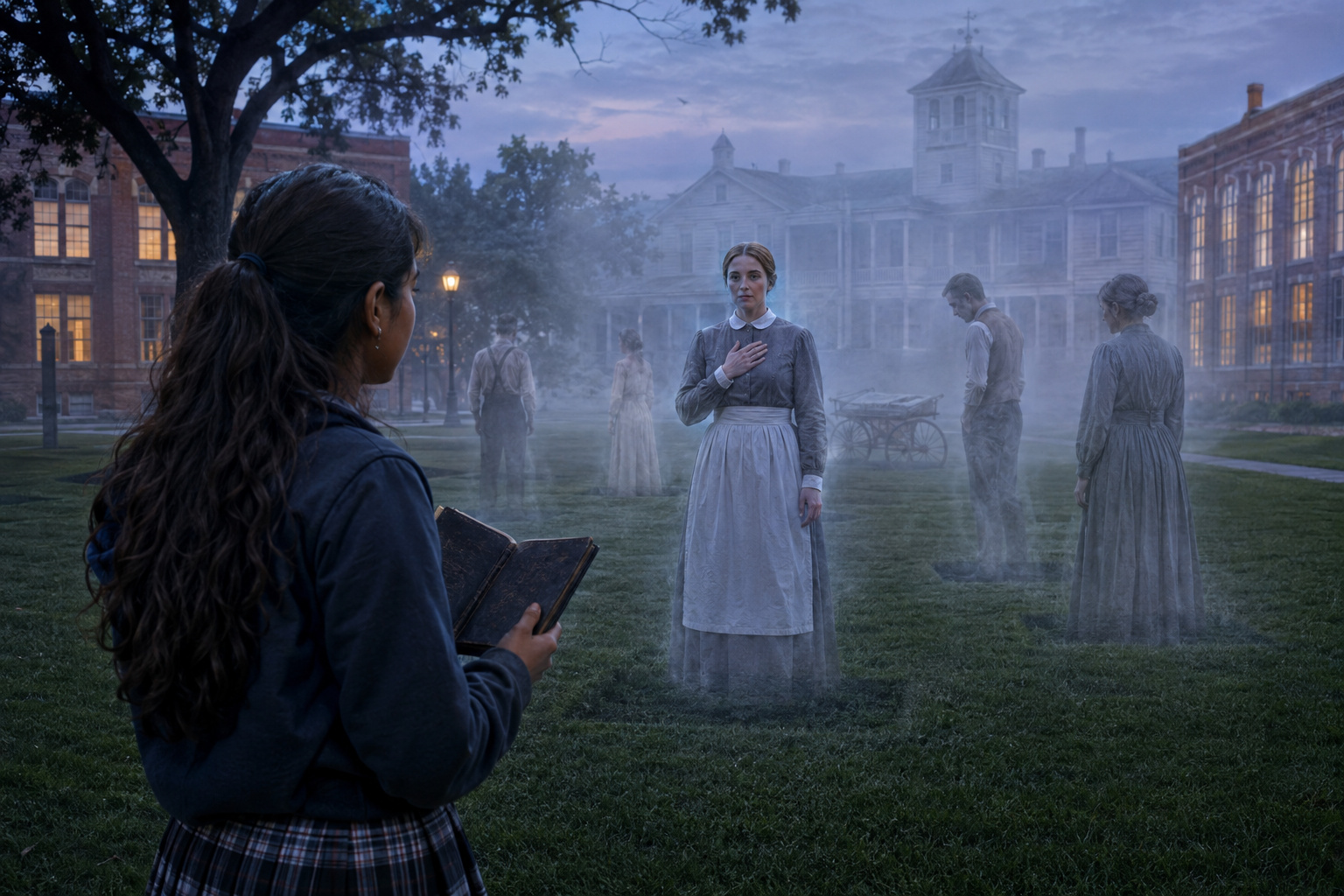
The Quad lay beneath a low silver fog. Dark rectangles had appeared in the grass, arranged in rows too orderly to be shadows. At the far end stood a woman in a gray dress and white apron. She held one hand against her chest. The other pointed at Leila’s notebook.
Leila stepped outside.
The doors slammed behind her.
All around the Quad, students began to appear.
At first Leila thought a crowd had slipped onto campus. Then she saw that their clothes came from many decades. A football player in an old leather helmet stood beside a girl in a calf-length skirt. A boy wearing a letterman sweater watched from beneath a tree that was no longer there. Their shapes shimmered, faded, and returned.
They were not the forgotten patients.
They were witnesses—the students and faculty who had glimpsed the dead over more than a century and had hurried away without speaking.
Beyond them, the hospital rose through the fog.
Its windows glowed weakly. Its walls overlapped the school buildings like two pictures printed on the same sheet. The squealing cart emerged from a doorway that belonged to neither place. Two orderlies pushed it toward an open grave.
The sheet on the cart moved.
“Eleanor!” Leila shouted.
The orderlies stopped.
The woman in the apron looked up. Her eyes were not angry. They were exhausted.
“Again,” she said.
“Eleanor Vale.”
One by one, pale figures rose from the dark rectangles in the lawn. Leila opened the notebook and began at the first page.
She read every name.
With each one, a grave closed. A shadow became a man or a woman. Faces sharpened. Eyes cleared. The dead turned toward one another with the startled recognition of travelers reunited at the end of a long journey.
When Leila reached the entries without names, she read the descriptions exactly as Eleanor had written them.
“Woman with silver comb.”
A woman touched her hair and smiled.
“Old man who sang in Spanish.”
A stooped figure lifted his head, and for one moment the Quad filled with a melody Leila’s grandmother used to hum.
“Infant from the north road.”
Somewhere in the fog, a baby stopped crying.
At last, only Eleanor remained.
Leila read her name once more.
The hospital windows went dark. The building folded into the fog, taking the orderlies, the cart, and the open graves with it. Eleanor placed a finger to her lips.
“You heard us,” she whispered. “But you did not hear all of us.”
Then she was gone.
The Last Page
The next morning, Leila returned to the Quad with Mr. Navarro and her history teacher. There were no graves in the lawn, no footprints, and no trace of the hospital.
But the notebook had changed.
Pages that had been blank were now crowded with names in dozens of different hands. Some were written in ink. Others appeared in pencil, chalk, crayon, and substances too faded to identify. The list continued through the back cover and across the inside of the black ribbon.
They made copies. They photographed every page. The original went into a sealed archival case with a label explaining that the names came from an unverified local legend. Leila proposed a memorial to the forgotten dead—not as proof that anyone lay beneath the school, but as a reminder that poverty should never erase a human life.
For a while, the Quad was quiet.
No floating figures crossed the lawn. No cart squealed through the halls. Faculty members who had once avoided the Quad after evening events began using it as a shortcut.
Then, on the anniversary of the night Leila found the notebook, the archive alarm sounded at 4:17 in the morning.
Security found the room locked and empty. Nothing had been stolen. The display case was intact.
On the glass, a new name had been traced in dust.
The archivist checked it against the notebook.
It was not there.
By sunrise, three more names had appeared beneath it—and from somewhere under the center of the Quad came the slow scrape of a shovel breaking ground.
This page is sponsored by Copy Bakersfield.
Visit our sponsor for full-service copying, printing, scanning and binding near the Bakersfield Courthouse.