The Man on the Clock
The Historic Fox Theater · Bakersfield, California
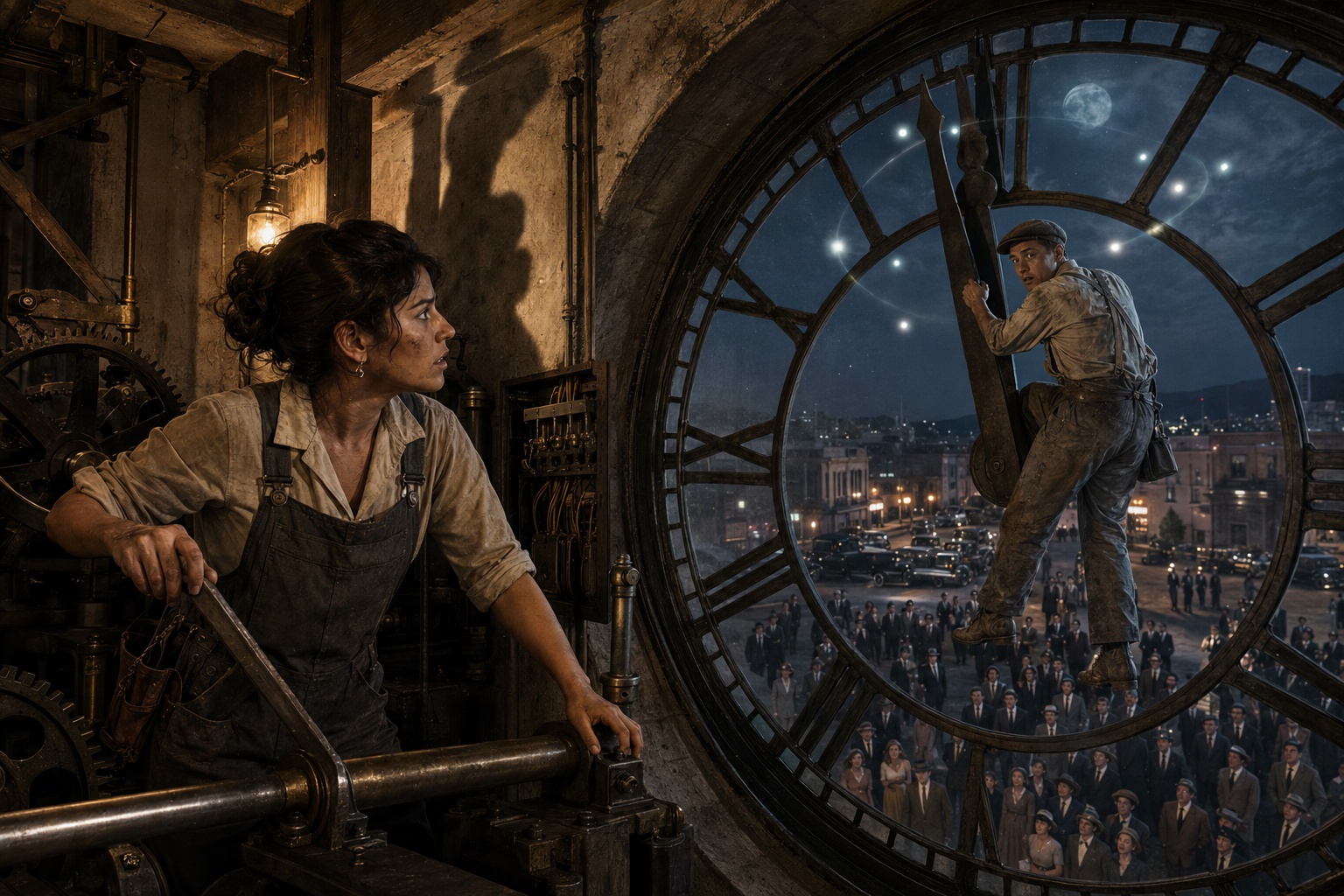 At 11:58 p.m., the Fox Theater’s clock began counting backward toward opening night.
Celia Mora saw it happen on the monitor in the lighting booth. She had aimed a small camera at the tower to test the exterior illumination before the next evening’s anniversary program. The clock read two minutes to midnight. Then the minute hand jerked counterclockwise.
11:57.
11:56.
A pale light circled the hands.
Celia leaned closer. At first she thought it was an insect reflecting the floodlights. Then the light stopped and rested on the minute hand like a tiny lantern.
Behind it stood a man.
He was no larger than a thumb on the screen, balanced high above H Street with one arm wrapped around the clock hand. His clothing was gray with dust. He turned toward the camera and lifted his free hand.
Not waving.
Warning.
The monitor went black.
Celia called security. The radio returned only orchestral music—a bright, brassy overture recorded through the hiss of an old film soundtrack. She recognized it from the archival reel scheduled for the anniversary. The reel was locked in the projection room and had no sound equipment attached.
Then the star lights in the auditorium ceiling came on.
One by one, they formed a night sky above fifteen hundred empty seats.
Celia left the booth.
The lobby smelled of fresh paint and winter rain instead of dust and summer heat. Beyond the glass doors, H Street had changed. Black automobiles lined the curb. Men in overcoats and women in fur-trimmed dresses crowded beneath a marquee advertising a Christmas Day opening.
No one outside moved.
Every face looked up at the clock.
The minute hand continued backward.
11:41.
A knock sounded overhead.
Three strikes. A pause. Three more.
Celia knew the service stairs reached the tower machinery. She also knew she had no permission to enter them alone. But the building had become something older than permission, and the man outside the clock was losing his grip.
She climbed.
Above the balcony, the theater narrowed into maintenance passages of steel, concrete and old timber. The music followed her through the walls. On one landing she found a wooden toolbox covered in white dust. Inside lay a rusted wrench, a coil of cloth-covered wire and a folded page torn from a calendar.
Someone had written across the date in pencil:
MIDNIGHT IS NOT AN HOUR.
IT IS A DOOR.
DO NOT GIVE IT YOUR SHADOW.
The tower room contained no modern clock motor.
A black iron mechanism filled the chamber, its gears turning with the slow strength of millstones. The machinery should have shaken the floor. It made no sound at all.
Behind the clock face, moonlight outlined the man clinging to the exterior hand.
He struck the glass again.
Celia found a narrow service panel and forced it open. Wind rushed into the room, carrying car horns, laughter and the excited murmur of the frozen 1930 crowd.
The man reached inside.
“Brake,” he gasped.
His hand was warm.
“Who are you?” Celia asked.
“The one who kept it from opening.”
She looked for a brake lever. A steel handle protruded between two gears, shuddering as the clock pulled backward.
11:24.
“Pull it,” he said. “I can’t hold the hand much longer.”
Celia seized the handle.
The mechanism stopped.
Every frozen person in the street lowered their gaze from the clock and looked directly at her.
The man climbed through the panel. He was young beneath the dust. His work shirt was torn at one shoulder, but he carried no wound from a fall. A dark stain circled each wrist as though he had been chained to the hands.
“You didn’t fall,” Celia said.
“Not the first time.”
He stepped away from the clock.
The brake handle tightened around Celia’s fingers.
Metal flowed across her knuckles like cooling wax. She tried to release it, but her skin had become part of the lever. Her shadow stretched across the floor, climbed the wall and slipped through the open panel onto the clock face.
Outside, the shadow formed the shape of a woman clinging to the minute hand.
The man brushed dust from his shirt.
“It needs a shadow to hold the hour shut,” he said. “Flesh wears out. A shadow can last.”
“How long were you there?”
He looked toward the motionless opening-night crowd.
“Long enough for rumor to become kinder than truth.”
The clock began moving again.
Forward now.
11:25.
11:26.
The crowd below stirred. Automobile engines coughed to life. The box office opened. The orchestra inside the theater tuned its instruments.
Celia felt each second pull more of her shadow through the clock face. Her feet grew transparent. Through them she saw the gears below.
“What happens at midnight?”
The man smiled.
“The premiere begins again.”
He descended the stairs.
Celia screamed after him, but applause swallowed her voice.
The theater was no longer empty. The 1930 audience filled every seat, applauding the blank screen. Their shadows climbed the walls toward the tower, thin ribbons feeding the gears.
11:47.
Celia reached with her free hand for the dusty toolbox. Her fingers closed around the rusted wrench. She drove it between the largest gear and its pinion.
The wrench snapped.
The gear chewed through the steel and continued.
11:54.
The pale light returned outside the clock. Then another appeared. And another.
Dozens of luminous spheres circled the hands.
They were not ghosts.
They were lost minutes—every moment surrendered in a dark theater, every hour an audience had willingly forgotten while the screen made another world seem real. The clock had hoarded them for decades.
Celia opened the calendar page and wrapped the cloth-covered wire around the words DO NOT GIVE IT YOUR SHADOW. She fed the paper and wire between the gears.
The mechanism caught the warning.
For the first time, the clock made a sound.
It screamed.
11:59.
The luminous minutes rushed through the service panel. They struck Celia’s shadow and tore it away from the clock face. More streamed down the stairwell, across the auditorium and through the doors. Wherever they touched the opening-night crowd, a person dissolved into rain, perfume, laughter or the fading warmth of a hand.
The young man reached the lobby.
The lost minutes found him beneath the marquee.
He looked up at Celia. For the first time, fear crossed his face.
“I served my hour!” he shouted.
The clock answered by pulling his shadow straight upward.
The man rose from the sidewalk, past the marquee and toward the tower. He struck the clock face without breaking it, passed through the glass and landed on the minute hand.
The mechanism released Celia.
Midnight arrived.
Nothing opened.
The star lights went dark. The seats emptied. Outside, H Street returned to the present.
On the clock face, the man clung to the hand again.
This time, he was looking down at the sidewalk.
Waiting for someone to look up.
Celia reached the lighting booth at 12:16 a.m. Security found her there at dawn, staring at the tower feed.
The recording showed no man and no backward-moving clock. It showed only a single pale orb circling the hands at 11:58.
Celia resigned from the theater, but she did not escape the lost minute.
Every clock in her home now stops at 11:59.
During that silent minute, her shadow leaves her feet, crosses the wall and begins climbing toward the ceiling.
Lately, it has started returning with white dust on its hands.
This page is sponsored by Copy Bakersfield.
Visit our sponsor for full-service copying, printing, scanning and binding near the Bakersfield Courthouse.